Here are the most recent blog posts that link directly to their full articles on my Substack page, Foxtrot Firefly’s Research Report. These posts take time to research and write up, and are formed from trying to keep my research skills sharpened and fresh. All of my research articles are free and readily available. You can support the work I do in my own time with a paid subscription.
Cheers,
Robin
- Scientific Inquiries into History

A side quest for an historian who has gotten sucked into Historical Fiction – again.
I admit – I wrote the title for this newsletter first, and as a result I am imaging something out of Jasper Fford’s Thursday Next series or out of Kate Quinn’s new book, The Astral Library. And considering that I was just listening to the most recent episode of What Should I Read Next? where Anne and her guest were talking about The Astral Library and the point in the book in which Anne of Green Gables comes up, I’m not really surprised. But I digress.
I have been sucked into a historical fiction series of mysteries recently. So engaged, in fact, that I finished the first 7 books in a little over a week – very nearly a book a day. And that series is the Wrexford and Sloane series by Andrea Penrose. But why might I use this as fodder for my history inquiry newsletter?
Because one of the marks of good historical fiction, in my mind, is when the author includes notes about the history that they used for the book at the back of the book. Andrea Penrose goes even further by putting essays on historical events on her website as well. What has been interesting about reading Wrexford and Sloane is that the characters are very interested in both the art and the science of the Regency era.
Steam engines, propellers for ocean voyages, Charles Babbage’s engine, and more make appearances on the pages of Andrea Penrose’s books. Though the fourth one really caught my eye because it had to do with the East India Company and risky trading – including a plot point that sounded exceedingly familiar when you consider the slightly earlier issues the EIC had with “Bengal Bills”. (I wrote about the EIC’s financial troubles of 1772 in one of my first newsletters in 2023.) What I think is also interesting about including just how complicated these transactions were into the plot of the book. They are difficult to explain at the best of times, but by making integral to the plot, it – interestingly – made it easier to understand.
Something else that has been on my mind, as much because of these books but because of everything else going on in my life, is just how much crossover there is between history and science. For starters, to understand modern technology, you have to know where it comes from. What is the basis that we are starting from? This is brought up even within the setting of the first book in the Wrexford and Sloane series, Murder on Black Swan Lane when old alchemical texts are being used by chemists.
That point needs to be made continuously. There is so much crossover between subjects and interests that finding those connection points and having students make those connections is really important. Yes, you need math to do physics, but you also need history and cause and effect to understand scientific discovery. You need a creative, problem-solving mind in piecing together historical puzzles the same way you do to look at an archaeological site or a geological site or to put together a computer program.
One of the biggest pieces of that puzzle for students that I have found over and over again is trying to bring an inquiry mindset to history. We often think about history as being a lecture course. We use it as an excuse to memorize dates and events and names. But the true study of history is so much more centered in the cause and effect. Who was where and when? How did that impact the outcome? Murder at King’s Crossing has a mention in it of Francis Cabot Lowell, whose story is a remarkable one that had wide reaching impacts on American manufacturing. Where would American manufacturing be now if Lowell had not gone to England and memorized the plans of the textile machines? Lowell, Massachusetts certainly wouldn’t exist as it does today.
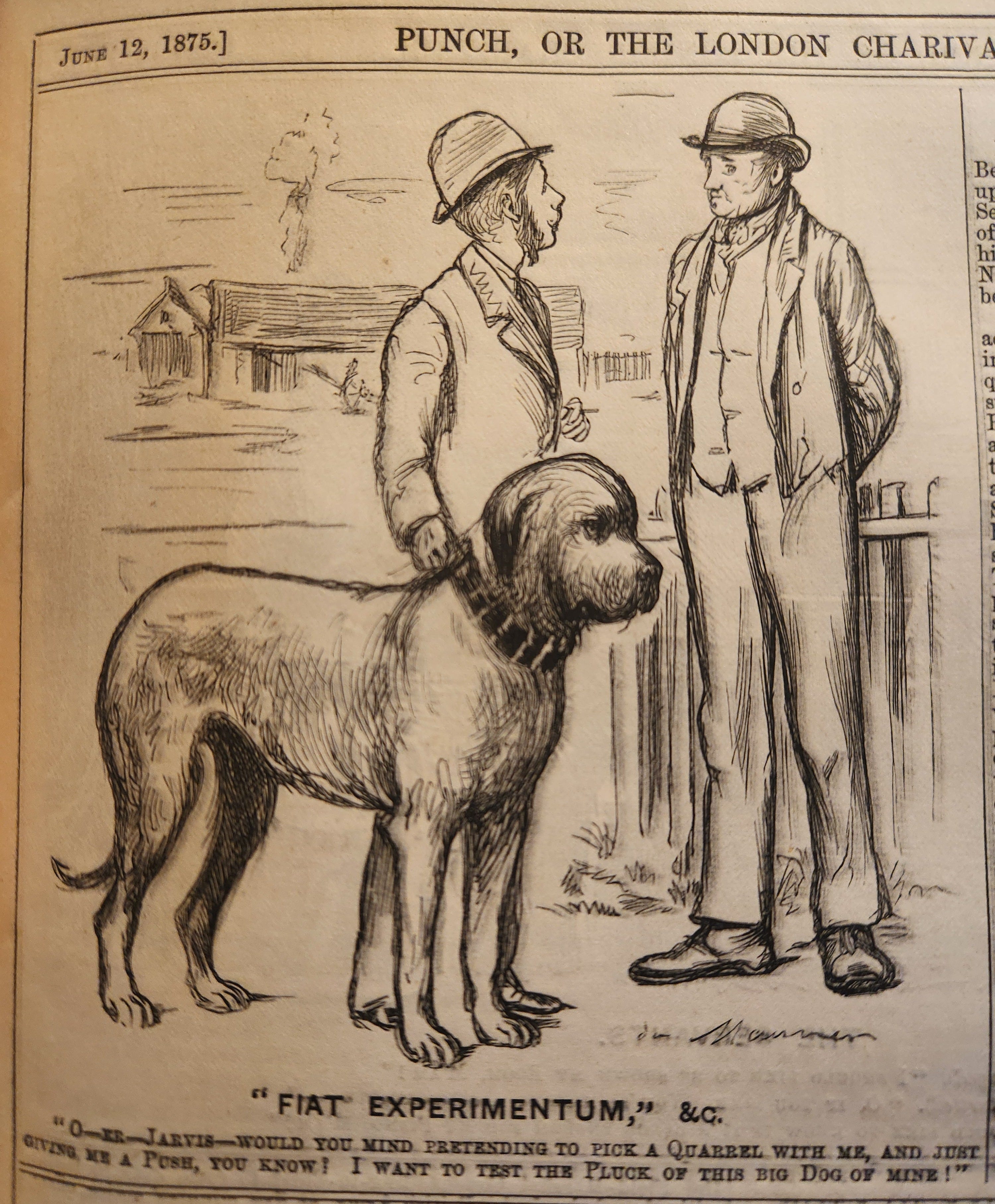
On a side note – if you’ve never seen a newspaper or magazine from the 19th century, it is very helpful to understand the character of A. J. Quill in the context of Wrexford and Sloane. There are many examples out there, and I admit the one below is not quite what I imagine when I’m picturing A. J. Quill’s work. Regardless, this is a picture I took of a drawing in Punch that I think both A. J. Quill and Andrea Penrose would appreciate. (The dog is almost big enough to remind me of Lord Wrexford’s Scottish deerhound.)
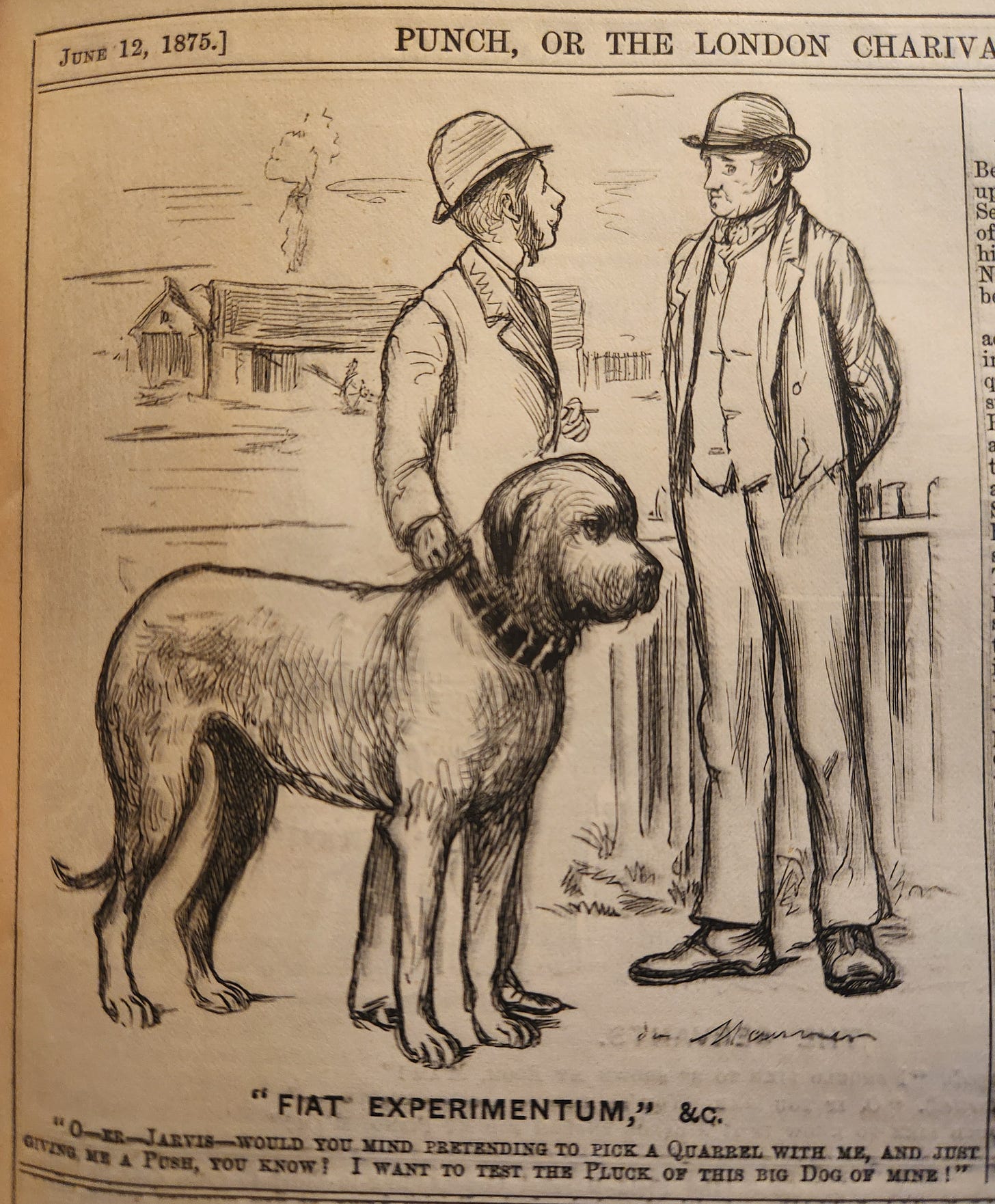
“ ‘Fiat Experimentum,’ &c.”, Punch Magazine, 12 Jun 1875. Text says: “O—er—Jarvis—would you mind pretending to pick a Quarrel with me, and just giving me a Push, you know? I want to test the Pluck of this big Dog of mine!”
Here are some of my previous articles on the importance of inquiry in history and historical fiction:
The Spirit of Historical Inquiry – FOXTROT FIREFLY
Using Fiction to Understand the Past – FOXTROT FIREFLY
To read this post on Substack, you can click here: Scientific Inquiries into History
To support my work hours, you can buy me a coffee, shop my Bookshop.org store front, or check out my TPT resources!
- Boston 1776
A Reflection on the 256th Anniversary of the Boston Massacre
It is that unhappy anniversary of the Boston Massacre today. Perhaps that is why I found myself picking up Serena Zabin’s The Boston Massacre: A Family History (2020) at the bookshop on Monday. My intent had been to do some digging into the local town history, but while that is still on the top of my to-do list, it is March, and I often find myself coming back here. Why? I can have my guesses. The first being that I spent so much time working just outside of the site, giving daily tours discussing what had happened on 5 March 1770. The longer you spend with a subject, the more you wonder about how it happened.
Last year, I discussed how Dr. Joseph Warren gave a speech on the anniversary in 1775. Sadly, 250 years ago today, Dr. Joseph Warren is no longer with us, having been killed at the Battle of Bunker Hill in June of 1775. It is now 1776. And in some respects, this will be a good thing: On 17 March 1776, the British will evacuate Boston.
I’m going to take a side-step here, and I think it’s an important one: Historical fiction can often be an excellent teaching tool. Why this side-step? Because last year, Laurie Halse Anderson published a fantastic middle grade book called Rebellion 1776. It starts right in on occupied Boston on 4 March 1776. (The paperback will be out on 26 May this year, if you want to wait.) However, it is important to note that one of the things that Laurie Halse Anderson included in this book, and part of the reason I am including it in this write up, is a quote from George Washington: “It was the 5th of March, which I recalled to [the soldiers’] remembrance as a day never to be forgotten—an engagement was fully expected and I never saw spirits higher, or more ardor prevailing.” Laurie explains in the citation that Washington was writing about the significance of the “Dorchester Heights success” falling on the anniversary of the Boston Massacre.1 Dorchester Heights was the bombardment of Boston by the Continental Army in March 1776, which would not have been possible without the cannons from Fort Ticonderoga, thusly delivered by General Henry Knox.
It being March of 1776, there is still so much of the war in the years ahead. The Declaration of Independence will be signed in July, but the war will not officially end until 1783. The last battle – the decisive victory at Yorktown – will be in 1781. We will celebrate the 250th Anniversary of Yorktown in September of 2031, which makes one wonder where we will be by then? But without that success on Dorchester Heights, on the sixth anniversary of the Boston Massacre no less, who knows where to war would have gone?
This month, I decided to put (almost) the full post in both places. If you’d like to receive my research ramblings in your inbox, you can go to the post on Substack to subscribe: Boston 1776 – by Robin Donovan Bocchiaro
In addition, I put a link to 2025’s post on the Boston Massacre at the end of the post on Substack because I did an overview of the events of 1770 in last year’s post commemorating the anniversary. If you’d like to skip straight there, you can click here: The Boston Massacre – by Robin Donovan Bocchiaro
- Where did Columbus Day come from?
These melting pot moments have a really important place in American history overall. Immigrating a little after, but also around the same time as the Irish, were the Italians. But there was a huge backlash (as there always seems to be) against immigrants in America. “For most of American history, anyone not Anglo-Saxon fell somewhere on a descending scale of human ‘pollution.’ […] … the immigrants arriving from southern and eastern Europe, the ‘scum and offscouring,’ as a former Virginia governor put it, newcomers who purportedly brought crime and disease and polluted the bloodlines of America’s original white stock.”1
“In 1891, a mob of about 20,000 New Orleans residents lynch 11 Italian Americans who have been incarcerated in a New Orleans jail. And when that happens, there’s actually an outcry from the Italian ambassador to America and from the Italian government. And in office at the time is Benjamin Harrison.”2 Harrison ends up hosting the original Columbus Day as a one-off. But after this, there is a “continuing recurrence of local celebrations of Columbus is in the early 20th century”, but “the rise of the Ku Klux Klan, especially in the North really hits Catholic communities very hard, Catholic and immigrant communities. Because the KKK in the 1920s focuses on immigrants as well as on Black Americans and on bootleggers, by the way as well.”3
It will be Franklin Delano Roosevelt that institutes Columbus Day as a national holiday (not a federal holiday) in 1934. The Knights of Columbus “increasingly begin to pressure the federal government to go ahead and recognize the importance of Italian Americans and Catholic Americans in society.”4 And Roosevelt, being from New York, and trying to firm up his hold on politics at the time, declares October 12th to be that national holiday.
To continue reading, please head over to my Substack newsletter, Foxtrot Firefly’s Research Report, where you can subscribe to get updates in your inbox!
Where Did Columbus Day Come From?
- “First of May, sir! Out of the Way!”
It being a fine, bright, mild morning, I got up early, to take a walk on the Battery, the most glorious place for a morning or evening stroll, to be found in the world. Coming down into the entry, I found it cluttered up with a specimen of almost every thing that goes to the composition of house keeping, and three or four sturdy fellows with hand barrows, on which they were piling Ossa upon Pelion. I asked what the matter was, but all I could get out of them was, “First of May, sir—please stand out of the way—first of May, Sir.” So I passed on into the street, where I ran the gauntlet, among looking glasses, old pictures, baskets of crockery, and all other matters and things in general. The side walks were infested with processions of this sort, and in the middle of the streets, were innumerable carts loaded with a general jail delivery of all the trumpery, good, bad and indifferent, that the carelessness of servants had broken, or the economy of the housewives preserved. […] while all the apology I got, was “First of May—take care, sir—first of May.”1
I’ve been spending a lot of time digging into the writings of early 19th century authors – and yes, that has mostly meant spending time with Washington Irving.
Now, Washington Irving had a friend, James Kirk Paulding, who wrote a satire about May Day in New York (quoted above) that drew a very vivid picture in my mind because it very nearly described a similar “holiday” in Massachusetts known as Allston Christmas. Except worse. Everyone across the city appears to have moved simultaneously. Pets were lost. A Brooklyn newspaper noted that the pet business did very well due to the number of lost or killed pets – goldfish being particularly prone to accidents on Moving Day. “If there are children in the household, they should be sent to visit some friend for the day,” suggests an advice column in the Brooklyn Times Union on 12 April 1902.
To read the remainder of this post, you can find it here: “First of May, sir! Out of the way!”
- Astoria and John Jacob Astor
When I set out to start a newsletter about research rabbit holes, the sort of deviation from what I was supposed to be doing research on is sort of what I was thinking of. I see a sentence or two that sends me into a totally different direction than I thought I would be heading.
I was reading through The Life and Letters of Washington Irving compiled and annotated by his nephew, Pierre Monroe Irving, when I found the following:
For upwards of a month I have been quartered at Hell Gate, with Mr Astor, and I have not had so quiet and delightful a nest since I have been in America. He has a spacious and well-built house, with a lawn in front of it, and a garden in rear. The lawn sweeps down to the water edge, and full in front of the house is the little strait of Hell Gate, which forms a constantly moving picture… I cannot tell you how sweet & delightful I have found this retreat; pure air, agreeable scenery, a spacious house, profound quiet, and perfect command of my time and space.1
As someone who currently lives in Astoria, Queens, I was somewhat brought up short by the reference to Hell Gate. The train bridge crossing the river right at Astoria Park is also known as the Hell Gate Bridge. My limited understanding, prior to this reading of Washington Irving’s letters, is that John Jacob Astor had nothing to do with Astoria. So I went digging. Where was Hell Gate?
To read more, you can visit the full post on my Substack newsletter: Astoria and John Jacob Astor – by Robin Donovan Bocchiaro
- Quebec and the American Revolution
Did you know that we invaded Quebec? The Quebecois sure know that we invaded Quebec. They don’t much like us up there. If you’ve ever taken a tour of the Citadel in Quebec City, you would also know this. Our tour guide spent a good long time telling us of all the things that the Quebecois do not like about the British or the Americans.
If you spend enough time in Vermont, you’ll also know that we invaded Quebec. When we weren’t invading Quebec, we were thinking about it. And part of that history is baked right into Vermont’s award-winning bleu cheese: Bayley-Hazen.
Quebec was not an insignificant threat. It was, as of the end of the French and Indian War, a British colony as well. And while the local French population was not enthused by this take over, they were also not ready to jump into another fight—especially not when the British government had told them they could continue to practice Catholicism as part of the Quebec Act.
To finish reading, please visit my Substack Newsletter, linked below.
Quebec and the American Revolution
- Digging the Fortifications on Breed’s Hill
On the 16th day of June, 1775, at night after roll call, I was furnished with a shovel and ordered to march. I was ordered to Bunker Hill, to use my shovel in throwing up a breastwork. I was compelled to labor till daylight. As soon as we were discovered, the British ships and batteries opened a tremendous fire upon us; this they continued till about ten o’clock in the day, when they began to cross Charlestown Ferry.
Here they landed their forces and soon after set fire to the town, then formed their troops and marched on toward us. As soon as they came within gun shot, they began to fire upon us, but our officers, thinking it best to reserve our fire, we withheld it until they came within four or five rods of us, when we were ordered to fire, which we did.1
It seems remarkable that just a couple of months after the people of Charlestown opened their doors and cared for the wounded soldiers stumbling back from Concord, that those same soldiers would light fire to Charlestown.
And yet, that is exactly what happened.
To finish reading, please visit my Substack Newsletter, linked below.
Digging the Fortifications on Breed’s Hill
- When Your Great-Grandfather Poses for a Statue
Every year around Patriots’ Day (in Massachusetts), a combination of photo memories and public posts from Minute Man National Historical Park remind us of a story from our family. That story?
Our great-grandfather claimed that he had posed for Daniel Chester French for the statue of the minute man that stands at the Old North Bridge. The likelihood that this story is true? Very low. Very, very low. Not entirely impossible. But very unlikely.
To read the rest, please click on the link to my Substack below.
- Riding the Hoofbeats of the Early Revolution
Today is 16 April 2025. We are only days away from what would be the opening shots of the American Revolution, 250 years ago this year.
Yes, I’ve been banging on about this since, well… Basically since I started this newsletter. 250 years ago this, 250 years ago that. I think you have all been getting the idea by this point.
Many of the important anniversaries thus far have been smaller events leading up to this point. Some of them are a bit bigger, such as the Boston Massacre, but we haven’t yet seen any real fighting. Protesting? Sure. Britain sending in military might because of the tossing of tea in the harbor, yes. And, yes, there was that incident with the Gaspee in Rhode Island. (Major incident, by the way. This gets talked about a lot in Rhode Island public schools and in almost every single Revolutionary War text, but isn’t taught as much outside of that. I hadn’t even heard of the Gaspee until I took a university seminar on Vermont history and there was a guy from Rhode Island in the seminar with me.)
The 250th commemoration of Lexington and Concord is THIS WEEKEND. For an overview of events you can attend in Massachusetts, you can visit Rev250 or the Minute Man National Historical Park website. The biggest event will be the Battle Road Tactical Demonstration, which will be at Minute Man NHP on Saturday, 19 April 2025. And as they say in this video, please take public transit if you’re planning to go!
So here we go: An Overview of Events 18 April 1775 – 19 April 1775.
To read more of this post, please click the link below for my Substack Newsletter!
- What Happened Yesterday
New Substack Newsletter out now!