A side quest for an historian who has gotten sucked into Historical Fiction – again.
I admit – I wrote the title for this newsletter first, and as a result I am imaging something out of Jasper Fford’s Thursday Next series or out of Kate Quinn’s new book, The Astral Library. And considering that I was just listening to the most recent episode of What Should I Read Next? where Anne and her guest were talking about The Astral Library and the point in the book in which Anne of Green Gables comes up, I’m not really surprised. But I digress.
I have been sucked into a historical fiction series of mysteries recently. So engaged, in fact, that I finished the first 7 books in a little over a week – very nearly a book a day. And that series is the Wrexford and Sloane series by Andrea Penrose. But why might I use this as fodder for my history inquiry newsletter?
Because one of the marks of good historical fiction, in my mind, is when the author includes notes about the history that they used for the book at the back of the book. Andrea Penrose goes even further by putting essays on historical events on her website as well. What has been interesting about reading Wrexford and Sloane is that the characters are very interested in both the art and the science of the Regency era.
Steam engines, propellers for ocean voyages, Charles Babbage’s engine, and more make appearances on the pages of Andrea Penrose’s books. Though the fourth one really caught my eye because it had to do with the East India Company and risky trading – including a plot point that sounded exceedingly familiar when you consider the slightly earlier issues the EIC had with “Bengal Bills”. (I wrote about the EIC’s financial troubles of 1772 in one of my first newsletters in 2023.) What I think is also interesting about including just how complicated these transactions were into the plot of the book. They are difficult to explain at the best of times, but by making integral to the plot, it – interestingly – made it easier to understand.
Something else that has been on my mind, as much because of these books but because of everything else going on in my life, is just how much crossover there is between history and science. For starters, to understand modern technology, you have to know where it comes from. What is the basis that we are starting from? This is brought up even within the setting of the first book in the Wrexford and Sloane series, Murder on Black Swan Lane when old alchemical texts are being used by chemists.
That point needs to be made continuously. There is so much crossover between subjects and interests that finding those connection points and having students make those connections is really important. Yes, you need math to do physics, but you also need history and cause and effect to understand scientific discovery. You need a creative, problem-solving mind in piecing together historical puzzles the same way you do to look at an archaeological site or a geological site or to put together a computer program.
One of the biggest pieces of that puzzle for students that I have found over and over again is trying to bring an inquiry mindset to history. We often think about history as being a lecture course. We use it as an excuse to memorize dates and events and names. But the true study of history is so much more centered in the cause and effect. Who was where and when? How did that impact the outcome? Murder at King’s Crossing has a mention in it of Francis Cabot Lowell, whose story is a remarkable one that had wide reaching impacts on American manufacturing. Where would American manufacturing be now if Lowell had not gone to England and memorized the plans of the textile machines? Lowell, Massachusetts certainly wouldn’t exist as it does today.
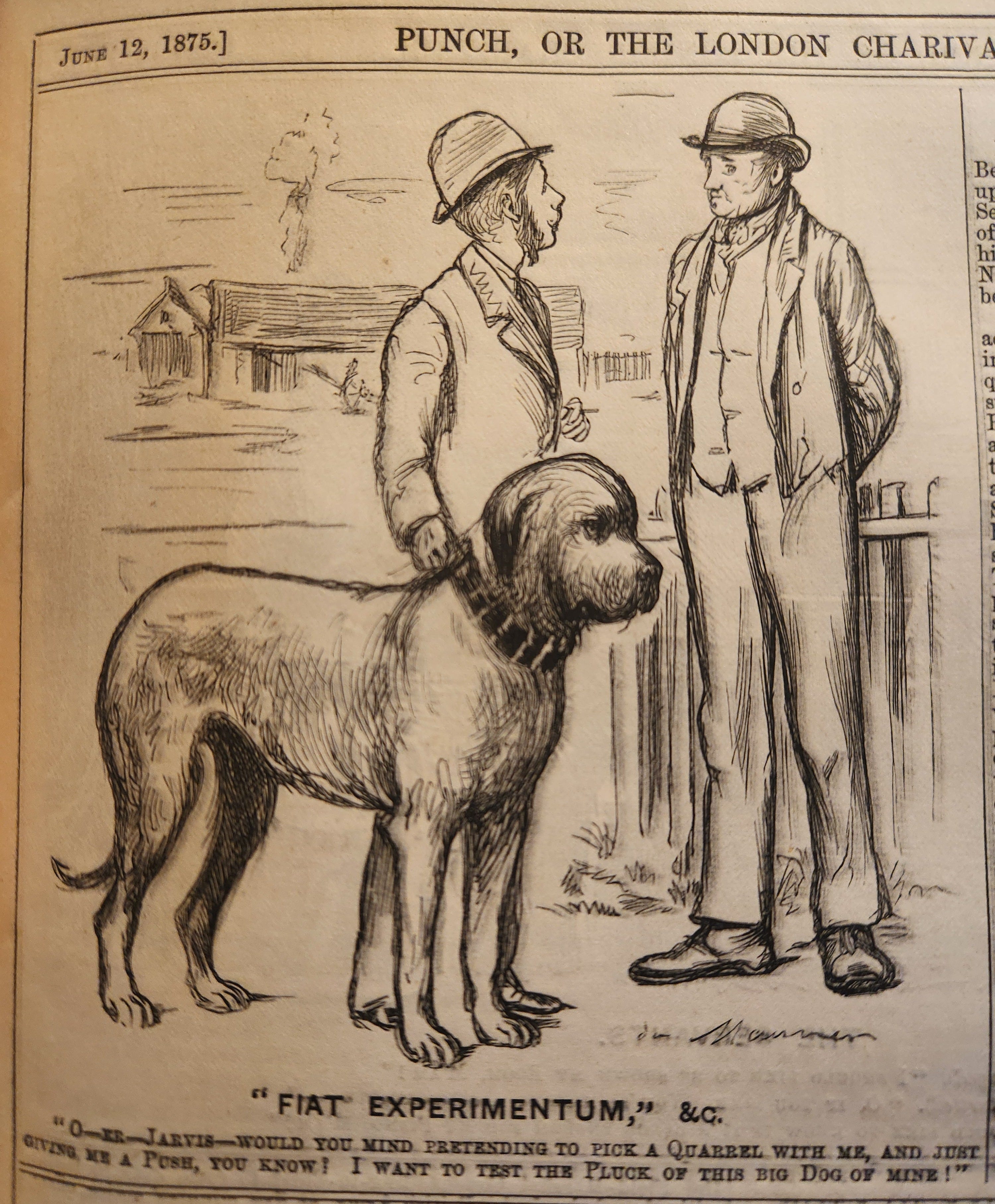
On a side note – if you’ve never seen a newspaper or magazine from the 19th century, it is very helpful to understand the character of A. J. Quill in the context of Wrexford and Sloane. There are many examples out there, and I admit the one below is not quite what I imagine when I’m picturing A. J. Quill’s work. Regardless, this is a picture I took of a drawing in Punch that I think both A. J. Quill and Andrea Penrose would appreciate. (The dog is almost big enough to remind me of Lord Wrexford’s Scottish deerhound.)
Here are some of my previous articles on the importance of inquiry in history and historical fiction:
The Spirit of Historical Inquiry – FOXTROT FIREFLY
Using Fiction to Understand the Past – FOXTROT FIREFLY
To read this post on Substack, you can click here: Scientific Inquiries into History
To support my work hours, you can buy me a coffee, shop my Bookshop.org store front, or check out my TPT resources!